
Domain Registration in India – Complete Guide 2026
Everything you need to know about registering a domain in India — from picking the right extension to choosing the best registrar, with real pricing and honest comparisons.
If you’re starting a business, launching a blog, or just trying to get your brand online, the first thing you’ll need is a domain name. It’s your address on the internet — and in India, where digital adoption has exploded over the last few years, getting the right domain early can make a real difference.
But here’s the thing — most guides on domain registration are either too technical or too vague. This one isn’t. Whether you’re registering your very first domain or switching from one registrar to another, this guide walks you through everything step by step, in plain language.
Let’s get into it.
What Is Domain Registration, and Why Does It Matter?
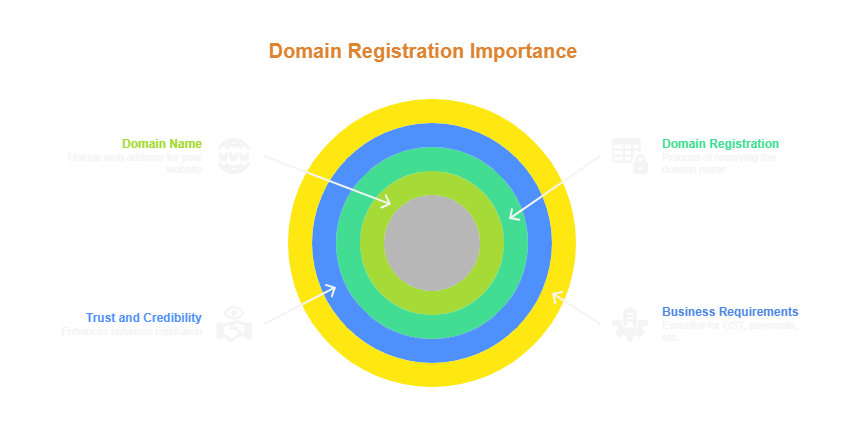
A domain name is basically the URL people type in to reach your website — something like “yourbusiness.com” or “yourstartup.in”. Domain registration is the process of officially reserving that name so no one else can use it while it’s in your name.
Think of it like buying a plot of land. The internet has limited “space” for names, and once someone registers a domain, it’s theirs for as long as they renew it. You don’t own it permanently — you lease it, usually year to year.
In India specifically, having the right domain builds trust with your audience. A business with a proper .com or .in address looks far more credible than one operating only on social media. And with GST registrations, payment gateways, and vendor onboarding all increasingly requiring a business website, this isn’t optional anymore — it’s a baseline.
Domain Extensions Explained: Which One Should You Pick?
The extension (or TLD — Top-Level Domain) is the part after the dot. Choosing the wrong one is a surprisingly common mistake. Here’s a breakdown of what’s available and what each one actually signals:
.com
The gold standard. Most people default to .com when typing a web address, which means you’ll lose less traffic to misremembered URLs. If your .com is available, grab it — even if you primarily operate in India. It signals an internationally ready business.
.in
India’s country code domain. Great for local businesses that want to establish a strong geographic identity. Google also tends to favour .in domains for India-based search results, which can give you a small SEO boost locally. It’s also usually cheaper than .com.
.co.in
Specifically meant for companies registered in India. If you’ve got a formal business entity and want to emphasise that, .co.in works well. It’s not as widely recognised as .in, but it carries a professional tone.
.org, .net, .io and others
.org is traditionally used for nonprofits or communities. .net works for tech-adjacent businesses. .io has become popular in the startup/SaaS world, though it’s pricier. Choose these only if your .com isn’t available or if the extension genuinely suits your brand.
How to Register a Domain in India – Step by Step
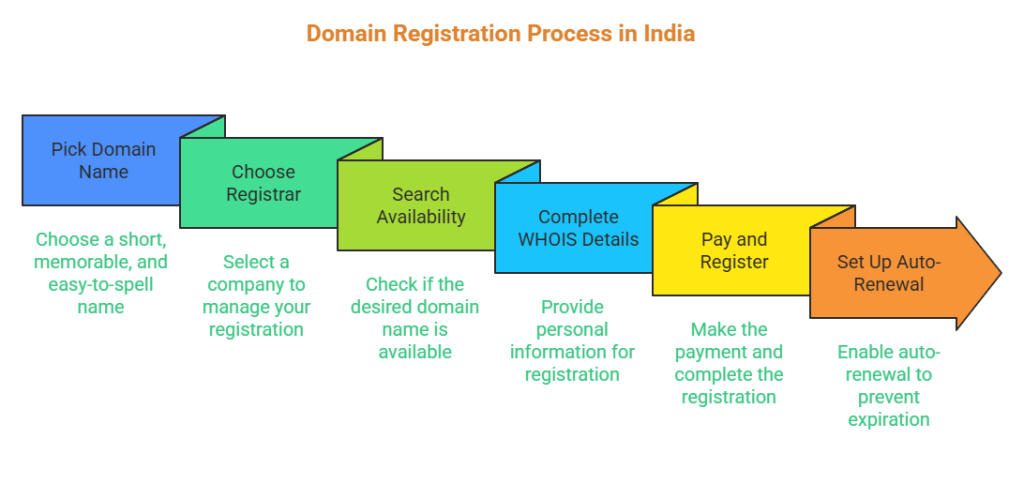
The process is simpler than most people expect. Here’s how it works:
- Pick your domain name. Keep it short, memorable, and easy to spell. Avoid hyphens and numbers where possible — they’re annoying to communicate verbally.
- Choose a registrar. This is the company that manages your registration. We’ve listed the best options below.
- Search for availability. Most registrars have a search bar right on their homepage. Type in your desired name and it’ll tell you immediately if it’s taken.
- Complete WHOIS details. You’ll need to provide your name, address, email, and phone number. For Indian registrations, this information is registered with ICANN (the global domain authority).
- Pay and register. Most registrars accept UPI, debit/credit cards, and net banking. The domain is usually active within minutes.
- Set up auto-renewal. This is the step most people skip — and then panic when their domain expires. Turn it on from day one.
Domain Pricing in India – What to Expect in 2026
Pricing varies quite a bit depending on the registrar and the extension you choose. Here’s a rough benchmark to help you gauge if you’re getting a fair deal: we have shared dotpapa pricing table for and better idea of domain pricing.
| Extension | Registration | Renewal | Transfer |
|---|---|---|---|
| .com | ₹949.00 | ₹1,298.70 | ₹1,233.70 |
| .site | ₹128.70 | ₹4,548.70 | ₹4,548.70 |
| .xyz | ₹258.70 | ₹1,818.70 | ₹1,818.70 |
| .online | ₹258.70 | ₹4,548.70 | ₹4,548.70 |
| .in | ₹649.00 | ₹984.00 | ₹679.00 |
| .io | ₹4,340.70 | ₹8,037.90 | ₹8,037.90 |
| .co.in | ₹569.70 | ₹639.70 | ₹629.70 |
| .ai.in | ₹569.00 | ₹639.00 | ₹629.00 |
Watch out for introductory offers that look cheap in year one but spike significantly at renewal. A domain priced at ₹99 in year one might renew at ₹1,200. Always check the renewal price before you commit.
Also factor in whether WHOIS privacy protection is included. Some registrars charge extra for this — it hides your personal contact details from public domain lookup tools, which is worth having.
Best Domain Registrars for India in 2026
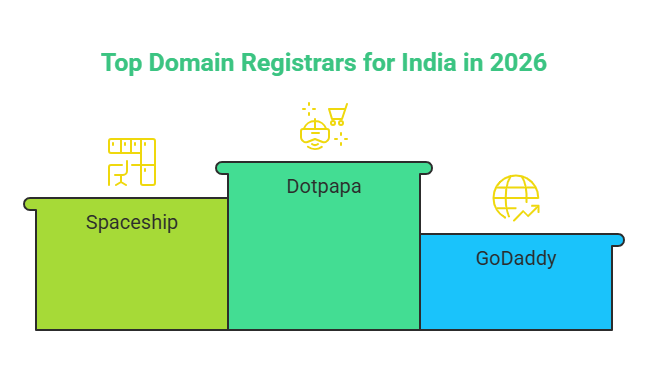
There are plenty of options out there in internet. Here’s an honest look at the most popular ones — including what they do well and where they fall short. please go through all the options and then choose.
1. Dotpapa — Best for Indian Businesses Wanting Full-Stack
Support
Dotpapa is an India-based registrar that’s quietly become a solid option for businesses that don’t just want a domain — they want everything to work together. They offer domain registration with very competitive pricing, and their hosting starts at ₹59/month, which is genuinely hard to beat.
What sets them apart is the support setup. You get direct call support, WhatsApp support, live chat, and a ticket system — all available 24/7. For anyone who’s ever been stuck with a down website at midnight and got an automated email telling them to wait 48 hours, this matters more than it sounds.
They also protect all hosted websites using CPGuard — a security layer that actively monitors and cleans malware from your hosting environment. Most budget registrars don’t include anything like this as standard. Dotpapa does.
Beyond domains, they provide shared hosting, WordPress hosting, cloud hosting, and VPS — so as your business grows, you’re not forced to migrate elsewhere. They’ve been operating for over two years and have verified reviews on Trustpilot. They also serve customers internationally, not just within India.
Best for: Small businesses, startups, and individuals in India who want a registrar that’s reachable, affordable, and doesn’t leave them alone when something goes wrong.
2. Spaceship — Best for Simplicity and Clean Pricing
Spaceship is a relatively newer registrar (from the team behind Namecheap) with a clean, no-nonsense interface. Pricing is transparent — what you see is close to what you’ll pay on renewal too, which is refreshing. Free WHOIS privacy is included across the board.
Best for: People who want a straightforward registration experience without upsell overload.
3. GoDaddy — Best Known, but Buyer Beware
GoDaddy is the biggest registrar in the world and has a strong presence in India. Their first-year deals are often very attractive — ₹99 for a .com isn’t uncommon during sales. The problem is renewal pricing, which tends to be significantly higher. They’ve also been criticised for aggressive upselling during checkout.
That said, they have a mature platform, solid uptime, and are familiar to most web developers. If you know what you’re getting into, they’re a workable option.
Best for: Buyers who want brand recognition and can navigate renewal pricing carefully.
4. Namecheap — Solid Value with Free Privacy Protection
Namecheap has built a loyal following for a reason — they offer competitive pricing, include free WhoisGuard privacy protection with every domain, and have a clean management panel. Renewal prices are also more reasonable than many competitors.
Support is primarily through chat and tickets, which works fine for most people. If you’re someone who prefers picking up the phone, you might find that limiting.
Best for: Tech-comfortable users who want good value and don’t need hand-holding.
5. Hostinger — Best if You’re Bundling Domain + Hosting
Hostinger is primarily a hosting company that also registers domains. They often bundle free domains with hosting plans, which can be great value if you need both. Their hosting is fast and their interface is beginner-friendly.
The caveat: domains registered through hosting bundles can sometimes make transfers trickier later. Read the fine print before committing.
Best for: First-time website owners who want a simple all-in-one setup.
Common Mistakes to Avoid When Registering a Domain
These are the ones people only learn about the hard way:
- Choosing a name that’s hard to spell. If you have to explain it every time someone asks for your website, it’s costing you traffic.
- Ignoring renewal pricing. Always check what year two and beyond will cost. Introductory offers can be misleading.
- Not turning on auto-renewal. Expired domains get snapped up by domain squatters almost immediately. Don’t let yours lapse.
- Registering the domain under someone else’s account. Always register in your own name or under your business entity. If the relationship with that person sours, getting your domain back can be a legal nightmare.
- Skipping WHOIS privacy. Without it, your personal contact details (phone, address, email) are publicly visible in domain lookup tools. This invites spam — and worse.
- Using trademarked terms in your domain. Even if the domain is available, using a trademarked brand name can get you into legal trouble down the line.
Frequently Asked Questions
Can I register a .in domain if I’m not based in India?
Yes, most .in domains are open for registration by anyone, regardless of location. A few sub-extensions like .gov.in and .mil.in have restrictions, but .in and .co.in are generally open registration.
How long does it take for a domain to go live?
Registration itself is near-instant. Once you register a domain and point it to a hosting server, DNS propagation (the time it takes for the change to spread across the internet) typically takes anywhere from a few minutes to 48 hours. Most of the time it’s done within a couple of hours.
Can I transfer my domain from one registrar to another?
Yes. Domain transfers are fairly standard — you’ll need an EPP/auth code from your current registrar, and the domain must be at least 60 days old and not locked. Most registrars have a transfer-in process that takes about 5–7 days to complete.
What happens if my domain expires?
There’s usually a grace period of 15–30 days after expiry during which you can renew it at the standard price. After that comes a “redemption period” where you can still get it back but at a much higher cost. After that, it goes back into the open market and anyone can register it.
Do I need a domain and hosting from the same company?
No. Domain and hosting can be with different providers — you just point the domain’s nameservers to your hosting. That said, having both in one place simplifies management, especially if you’re not comfortable with DNS settings.